
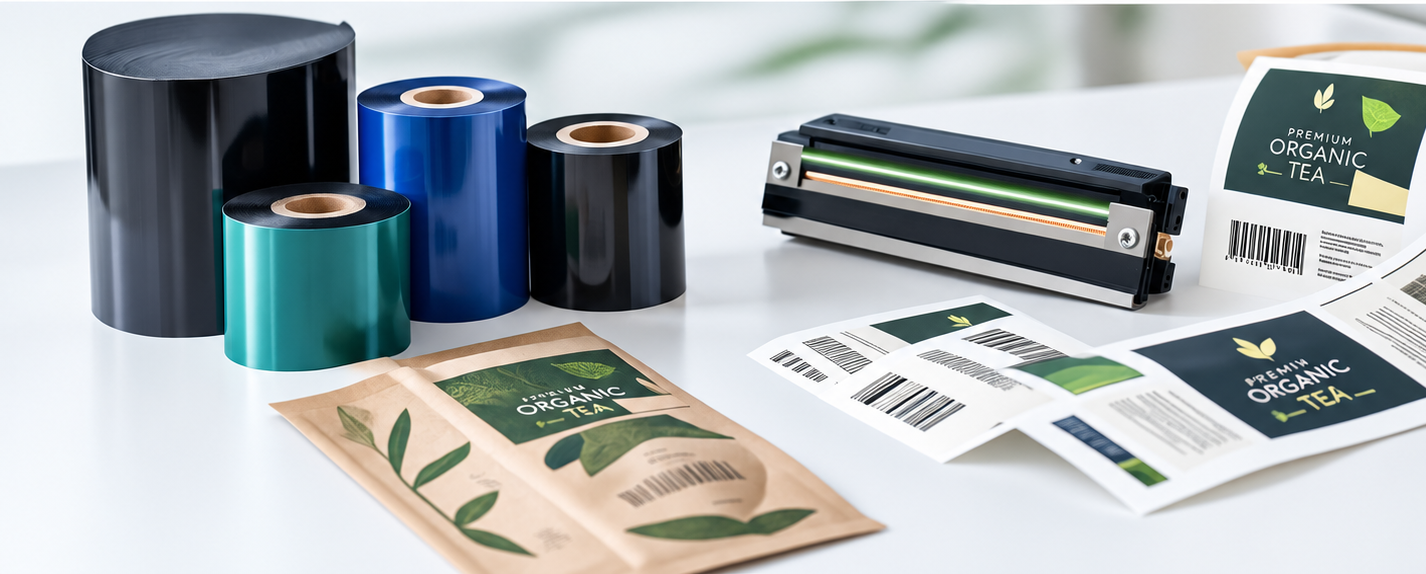
 From smarter traceability and production efficiency to 2D barcodes and sustainability, thermal transfer printing is evolving beyond the ribbon itself.
Thermal transfer ribbon (TTR) and thermal transfer overprinting (TTO) have long played an important role in product identification, labelling and packaging. But as manufacturing becomes more automated and supply chains demand greater visibility, the role of thermal transfer printing is evolving.
Today, it is no longer just about producing a clear print. It is about ensuring consistent print quality, supporting traceability, improving production efficiency and reducing unnecessary waste.
Here are four key trends shaping the future of the TTR and TTO industry.
Thermal transfer ribbon may be a small component in the production process, but its impact extends far beyond printing.
From logistics and warehousing to manufacturing, retail and flexible packaging, printed information helps businesses identify products, track batches and maintain supply chain visibility.
As traceability requirements and automation continue to evolve, reliable printing becomes increasingly important. Barcodes, product labels and packaging codes must remain clear, readable and suitable for their intended applications.
This makes ribbon selection more than a purchasing decision. The right ribbon must match the printer, substrate, operating conditions and required print durability.
The takeaway: Reliable identification starts with choosing the right ribbon for the application.
In high-speed manufacturing and packaging environments, even small production interruptions can affect overall efficiency.
Ribbon changes, failed prints, material waste and inconsistent print quality can all contribute to downtime and additional operating costs.
For TTO applications in particular, ribbon utilisation and changeover frequency are important considerations. Choosing suitable ribbon lengths and formulations, alongside appropriate printer settings, can help businesses improve production efficiency.
However, compatibility alone does not guarantee optimal performance. The ribbon must also perform reliably at the required printing speed and on the intended packaging material.
Instead of focusing solely on the price per roll, businesses should consider the wider cost of printing, including waste, downtime, rework and print consistency.
The takeaway: The real value of a ribbon lies not only in its price, but also in how reliably and efficiently it performs.
Barcodes are evolving from simple product identifiers into tools that can support richer product information and improved traceability.
Traditional one-dimensional (1D) barcodes remain widely used, while two-dimensional (2D) barcodes, including QR codes and DataMatrix codes, offer opportunities to encode more information in a compact space.
GS1’s Sunrise 2027 initiative is encouraging the retail industry to prepare for the scanning and processing of appropriate 2D barcodes at point of sale alongside traditional 1D barcodes.
For manufacturers and packaging businesses, this shift brings greater attention to print quality, contrast, code dimensions and scannability.
A code that contains more information is only useful if it can be printed accurately and read reliably.
For TTR and TTO applications, this reinforces the importance of matching the ribbon, printer and packaging substrate to the requirements of the code.
The takeaway: As packaging carries more data, reliable coding and marking becomes even more important.
Sustainability in thermal transfer printing is about more than simply using less ribbon.
It also involves choosing suitable materials, reducing unnecessary waste, minimising failed prints and rework, and improving production efficiency.
A ribbon that is poorly matched to its application may contribute to printing defects, rejected products or repeated production runs. Selecting the right solution can help reduce these avoidable losses.
At the same time, material and formulation developments need to balance environmental considerations with print quality, durability and application requirements.
The goal is not simply to use less material at any cost. It is to make better-informed choices that support reliable printing while reducing unnecessary consumption and waste.
The takeaway: Smarter ribbon selection and better process control can contribute to more efficient, less wasteful printing operations.
These four trends point towards a broader shift in the thermal transfer industry.
The future of TTR and TTO will not be defined by one technology alone. It will depend on how effectively ribbons, printers, packaging materials, data requirements and automation work together.
For manufacturers, converters and packaging specialists, understanding this relationship can help improve print reliability, manage operating costs and prepare for changing production requirements.
At Transam Industries, we believe reliable thermal transfer printing starts with understanding the application. By matching the right ribbon to the printer, substrate and production environment, businesses can work towards consistent print quality and more efficient operations.
A ribbon may be small, but its role in modern production is growing.
The question is no longer simply, “Which ribbon should we use?” It is, “How can we make every print count?”
GS1. 2D Barcodes at Retail Point-of-Sale Implementation Guideline. https://ref.gs1.org/guidelines/2d-in-retail/
U.S. Environmental Protection Agency (EPA). Sustainable Manufacturing. https://www.epa.gov/sustainability/sustainable-manufacturing
